Play Double FreeCell
Two decks, ten columns and eight foundations - the full FreeCell marathon.Getting to know Double FreeCell
In a nutshell: Two decks, ten columns and eight foundations - the full FreeCell marathon. You play with 2 decks (104 cards), it's rated marathon, and winnable but long - expect 20-minute games.
Double FreeCell takes everything you love about the classic and doubles the scale. Two full decks - 104 cards - are dealt face up into ten columns, with six free cells above and eight foundations waiting, two for each suit, every one built up from Ace to King. The tableau still builds downward in alternating colours, any card may fill an empty column, and your supermove size grows with free cells and empty columns exactly as it does in one-deck FreeCell. What changes is the sheer amount happening at once. With two of every card in play, there are far more simultaneous plays to track, more ways to tangle a column, and a longer road to a clean board. A single game can stretch past twenty minutes of steady, absorbing play. If you want the familiar FreeCell logic to sink your teeth into for a good while, this is the marathon version to settle in with.
Double FreeCell by the numbers
| Goal | Because two decks are in play, there are eight foundations - two per suit - and each one builds up from Ace to King. You win when all eight are complete, which means shepherding two of every card home rather than one. |
|---|---|
| Decks used | 2 standard 52-card decks - 104 cards in play |
| Difficulty | Marathon |
| Chance of winning | Winnable but long - expect 20-minute games |
| Family | Two-Deck |
How a game of Double FreeCell plays out
Eight foundations to fill
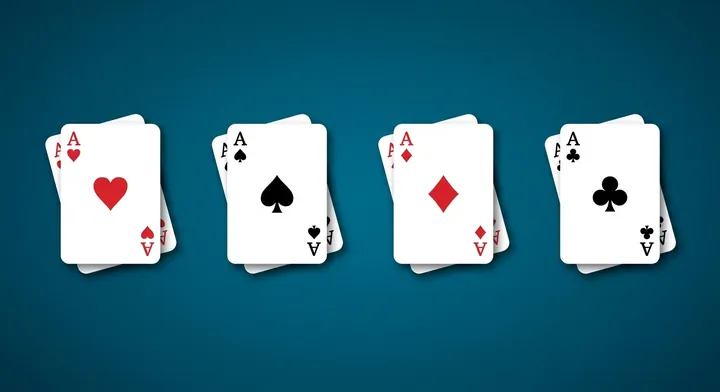
Because two decks are in play, there are eight foundations - two per suit - and each one builds up from Ace to King. You win when all eight are complete, which means shepherding two of every card home rather than one.
Two decks on the table
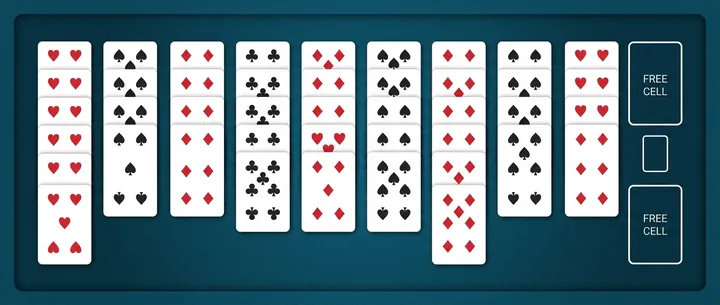
The full 104-card double deck is dealt face up, so nothing is hidden but there is twice as much to read. Two copies of every card means more options and more tangles, and it pays to scan the whole wide board before you plan your opening.
Ten columns, six cells
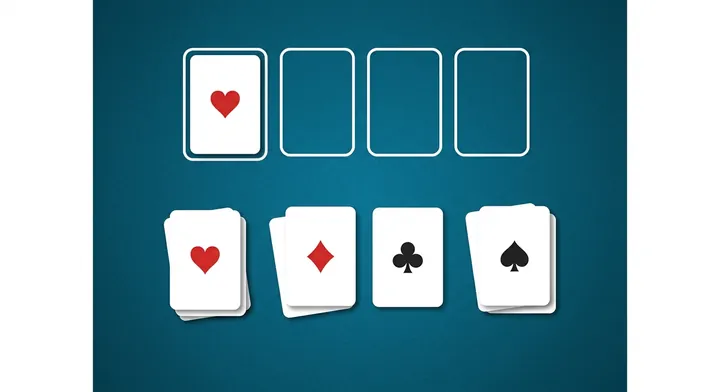
The cards spread across ten tableau columns, and six free cells sit above as temporary parking. You build the columns downward in alternating colours, just like classic FreeCell, only across a much larger playing field.

Moving long alternating runs
Ordered alternating-colour runs move as supermoves, sized by the usual (free cells + 1), doubled per empty column. With six cells available and a wide board, you can build and shift impressively long runs when you manage your resources well.
Empty a column, gain power
Any card may fill an empty column, and clearing one boosts your supermove capacity just as in FreeCell. On a ten-column, two-deck board, a well-used empty column is a major asset, so open one when you can and protect it.
Where Double FreeCell comes from
Double FreeCell is part of a long tradition of two-deck patience games, which card players have enjoyed for generations as a way to make a favorite game larger and more involved. Doubling the deck is a classic move in the patience world - it multiplies the possibilities, extends the play, and turns a short diversion into a proper sitting. Applying that idea to FreeCell was a natural step once the single-deck game had won its huge following.
When FreeCell exploded in popularity through home computers, software collections quickly began offering scaled-up versions to satisfy players who wanted more. Double FreeCell answered that appetite by keeping every rule of the original - alternating-colour building, any-card empty columns, the supermove formula - while widening the board to ten columns, adding two cells for six total, and providing eight foundations for the doubled deck.
The result is a game that feels instantly familiar yet plays quite differently, trading the quick, sharp puzzle of single-deck FreeCell for a sprawling marathon of planning and stamina. It has become the go-to choice for players who love the FreeCell idea and simply want more of it, and it remains a popular fixture wherever the broader family is offered.
Winning at Double FreeCell
💡 Top tip: Think in terms of the whole board before you commit - with 104 cards and ten columns, the biggest mistake is making a tidy local move that quietly buries a card you needed elsewhere, so scan widely first.
Tips that move the needle
- Free your Aces and twos early, and remember there are two of each. Getting all eight foundations moving keeps the enormous board from clogging up as the game goes on.
- Guard your six free cells and try to keep a couple open. On a board this size it is easy to fill them without noticing, and full cells rob you of the room you need to untangle long columns.
- Empty columns are powerful here because they multiply your supermove size across a huge layout. Work to open one and then reuse it rather than filling it on the first tempting card.
- Pace yourself - this is a marathon. Long runs and many simultaneous plays reward patient, methodical play over rushing, so take the time to plan each phase of the game.
- Build long alternating-colour runs to move groups efficiently. With two decks there are more chances to assemble big sequences, and moving them as supermoves saves enormous effort.
- Track duplicate cards carefully. Because every rank and suit appears twice, it is easy to confuse which copy you are planning around, so keep clear on which card serves which purpose.
Sharper play for Double FreeCell
- Divide the wide board into zones in your mind and work them in turn. Trying to hold all ten columns and 104 cards in focus at once invites mistakes, so plan a region, act, then reassess the whole layout.
- Manage six cells as a genuine resource pool, not casual parking. Keep at least two open through the midgame, because on this scale a full bank of cells can strand a long run you were counting on moving.
- Open and reuse empty columns aggressively - their multiplier matters more here than anywhere. A single empty column can lift your supermove capacity enough to relocate the long alternating runs the big board produces.
- Advance both foundations of a suit at a similar pace. Letting one Ace-to-King pile race far ahead of its twin can strip away landing spots you need for the other copies of low cards still in play.
- Assemble long alternating runs deliberately, since two decks make them achievable. A single well-planned supermove of six or eight cards saves the tedium of shuffling those cards one at a time across ten columns.
- Label the duplicate cards in your head - this heart six versus that heart six - so your plan does not collapse when you reach for the wrong copy. Confusing duplicates is the signature error of two-deck play.
- Because games run long, checkpoint your position mentally every so often. Confirm your cells, empty columns, and foundation progress before each major push, so a twenty-minute effort does not unravel from one overlooked detail.
Slip-ups to sidestep
- Racing one suit up the foundations - with two of each suit you strand the twin if you climb unevenly.
- Letting all six cells fill - across 104 cards a full set of cells can lock an enormous board.
- Ignoring empty columns on a wide board - with ten columns, one empty column is worth a fistful of cells.
- Moving long runs without a plan - Double FreeCell is a marathon, so map each big relay before you start it.
Cousins of Double FreeCell
FreeCell
The single-deck original with four cells and eight columns, offering the same alternating-colour logic in a sharp, quick puzzle rather than a marathon.
Relaxed FreeCell
A gentle single-deck game with free supermoves and any-card empty columns, a good warm-up before committing to Double FreeCell's length.
Challenge FreeCell
The single-deck game squeezed to one or two cells, trading Double FreeCell's abundance for a tense, resource-starved test.
Seahaven Towers
Another ten-column game, but single-deck and same-suit with Kings-only gaps, contrasting Double FreeCell's roomy alternating-colour approach.
ForeCell
A tight single-deck relative with full starting cells and Kings-only empty columns, the opposite of Double FreeCell's generous six cells and any-card gaps.
Your Double FreeCell questions answered
How many cards are in Double FreeCell?
One hundred and four - two complete 52-card decks shuffled together. That is why there are ten columns, six cells, and eight foundations instead of the single-deck game's smaller setup.
Why are there eight foundations?
With two decks, every suit appears twice, so you need two foundations per suit - eight in all. Each is built up independently from Ace to King, and all eight must be completed to win.
How does the tableau build?
Downward in alternating colours, exactly like classic FreeCell. A red card lands on a black card of the next rank up, so the core building logic you already know applies across the bigger board.
Can any card fill an empty column?
Yes. Like standard FreeCell, Double FreeCell lets any card fill a cleared column, and doing so boosts your supermove capacity. On such a large layout, that flexibility is especially valuable.
How long does a game take?
Longer than single-deck FreeCell - often around twenty minutes or more. There are simply twice as many cards to move home, so plan for a lengthy, absorbing session rather than a quick game.
How big can my supermoves get?
They follow the familiar (free cells + 1), doubled for each empty column. With six cells and a wide board, you can move quite long runs, especially once you have opened one or more empty columns.
Is Double FreeCell harder than the classic?
It is more of an endurance test than a harder puzzle. The rules are the same and most deals are winnable, but the volume of cards and simultaneous plays makes it easy to lose track, so care matters more than raw difficulty.
Do I need to keep the two decks separate?
No. The decks are shuffled together and played as one pool of 104 cards. Any valid copy of a card can go on any legal spot; you never have to match cards to a particular deck.
What is the main challenge of two decks?
Keeping track of everything. With duplicates of every card and ten columns, the board holds far more information, and the difficulty comes from managing that complexity without burying cards you need.
Should I rush cards to the foundations?
Be measured. As in FreeCell, a low card left in play can be a landing spot, and with two copies of each rank you have more flexibility, so send cards up when it clearly helps rather than automatically.
Is it good for a longer play session?
Very much so. Double FreeCell is designed for when you want to settle in and enjoy the familiar logic at a larger scale, making it ideal for a relaxed but engaging stretch of play.
Can Double FreeCell be played head-to-head?
Yes. It works well as a race on the same seeded deal, where two players tackle an identical 104-card layout. The marathon length makes for a satisfying, drawn-out contest of planning and stamina.
Keep exploring FreeCell
- The full FreeCell rules hub - every variant, side by side.
- The FreeCell glossary - look up terms like free cell, supermove and marathon.
- The FreeCell FAQ - answers to the questions players ask most.
- Today's daily challenge - one shared deal, one shot, everyone's on the same board.
Ready to try something different? Compare Double FreeCell with every other game in the FreeCell rules hub, or jump straight into the full list of FreeCell games.
Last updated .