Skill Games vs Luck Games — What Makes FreeCell Different From the Rest
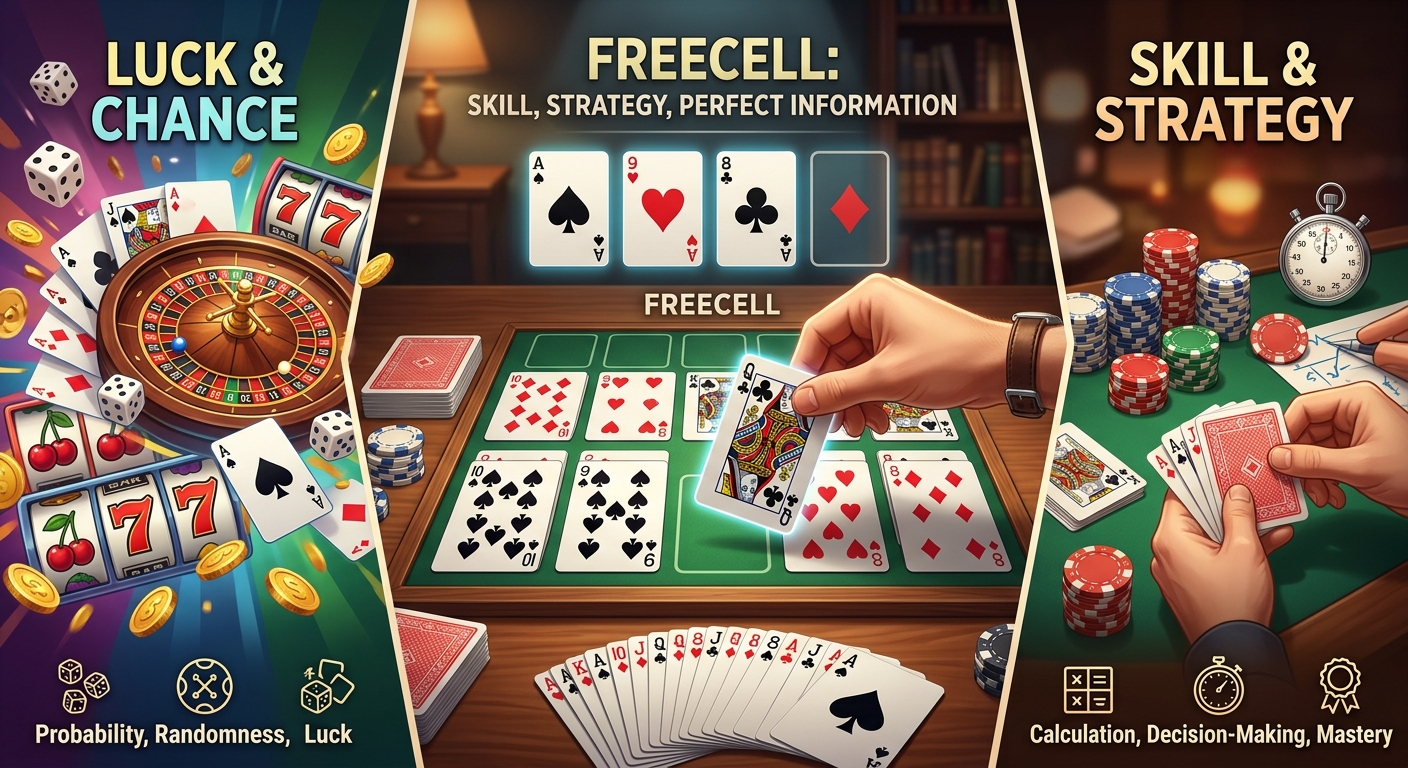
There is a moment in FreeCell, usually around move twelve or fifteen, where the entire game crystallises. Every card is visible. Every option is sitting right in front of you. And you know, with absolute certainty, that whatever happens next is entirely your doing. No hidden deck waiting to ruin your plans. No dice roll about to change everything. Just you, the cards, and the decisions you make. That feeling is genuinely rare in gaming. FreeCell gives it to you every single time you play.
At a Glance: Skill vs Luck in Card Games
- FreeCell deals every card face-up from the start, removing randomness entirely
- Luck-based games use hidden information or dice rolls as their core mechanic
- In pure skill games, your mistakes are traceable, reviewable, and genuinely instructive
- Improving at FreeCell means building better mental models, not just playing more hands
- Understanding where FreeCell sits in broader game design makes you a more thoughtful player
Why Most Card Games Keep You Guessing
Start with what most card games actually are. Klondike solitaire, the version most people know simply as "solitaire," draws cards from a face-down pile. You never know what is coming next. That uncertainty is not a flaw. It is the game's central appeal. You play the odds. You weigh probabilities. Sometimes you win. Sometimes the deck simply was not on your side.
Snap, Crazy Eights, and War are games where the cards do the talking and you respond. The draw of a card changes everything. You are not constructing a ten-move sequence. You are reacting moment to moment. That reactivity is fun. It is low cognitive load in the best possible way. You can pick these games up with almost no mental preparation and have a genuinely enjoyable time.
Even in more complex card games like Poker, a meaningful portion of any individual session sits outside your control. You can play perfectly and still lose. The skill emerges over hundreds of hands, not within a single round. The short-term noise of luck smooths out across time, but it never disappears entirely. You are always, at some level, managing probability rather than solving a fixed puzzle.
The Opposite End of the Spectrum, Where Dice Rule Everything
Some games push randomness to the extreme and become exercises in probability management rather than structured decision-making. Cooperative board games often work this way. You are not competing against another player. You are trying to survive a system that is designed to beat you, and the dice are the final judge of your fate.
The mechanics behind elder sign dice are a clear illustration of this. In that system, outcomes are governed entirely by what you roll. You can mitigate risk slightly with items and special abilities, but the dice are the engine that drives everything forward. A bad run of rolls can end a game that was going brilliantly. A lucky streak can rescue a session that looked entirely lost. That tension is exactly the point. The game is built around probability as a storytelling device, and the drama lives inside the uncertainty.
This is a completely legitimate design philosophy. Unpredictability creates suspense. Cooperative dice games carry a particular magic because the whole group leans forward together, hoping for a result. The collective groan or cheer is part of the experience. It is social and emotional in ways that a quiet solo puzzle rarely is. The design serves a different purpose entirely, and it serves it brilliantly.
What Happens When You Remove Luck Completely
FreeCell is about as far from a dice game as it is possible to get. From the first moment a deal appears in front of you, every single card is visible. All 52 of them, arranged across eight columns. Four free cells. Four foundation piles waiting to be built. Nothing is hidden. Nothing is random.
The documented solvability record for FreeCell is striking. Fewer than 0.001% of standard deals have no solution, which means almost every hand you are dealt is genuinely winnable. The famous exception, deal number 11982 from the classic Windows version, has been verified as unsolvable through exhaustive computation. But it remains a curiosity rather than a common experience. The cards are not stacked against you. They are simply waiting for you to find the path.
That changes the relationship between you and the game entirely. You are not hoping for a good draw. You are looking for a sequence that works. The cards are fixed from the moment the game begins. The question is whether your thinking is flexible enough to find the solution that is almost certainly already there.
How Planning Changes When the Board Is Fully Open
In a luck-based game, planning only reaches as far as the next random event. You can think three moves ahead, but a card flip or a dice roll will likely redefine your options before you get there. Deep planning gets partially wasted on possibilities that never materialise. The smart play is to adapt continuously rather than commit to a long sequence in advance.
FreeCell does not ask you to adapt to surprises. It asks you to think further ahead than feels comfortable. Moving a card into a free cell might look like progress in the moment. But if that free cell is still occupied four moves later, precisely when you desperately need the space, the decision was flawed from the beginning. The game rewards planning that stretches across the whole board, not just the next two turns.
This is a genuinely different cognitive mode. You are building and testing mental models of what the board will look like eight, ten, or twelve moves from now. You are mentally simulating futures rather than reacting to the present. That kind of thinking does not come naturally to most people. It develops with practice. And because FreeCell gives you all the information upfront, the practice actually transfers into measurable skill over time.
Mistakes in FreeCell Mean Something Real
In a luck-based game, a bad outcome sometimes just means you had bad luck. That can be frustrating, but it is also oddly comfortable. The game did not beat your thinking. The randomness beat your position. You can walk away without feeling that you made a fundamental error in judgement.
FreeCell does not offer that escape. If you lose a solvable deal, the cause is always in your decisions. You moved the wrong card. You used a free cell too early. You blocked a column you needed three moves later. The game is a mirror that reflects your reasoning back at you without softening the image.
That is not comfortable. But it is honest. And that honesty is what makes FreeCell genuinely instructive over time. The thinking errors that trip players up most often tend to follow recognisable patterns:
- Using all four free cells too early and leaving no room to manoeuvre
- Prioritising visible short-term progress over longer planned sequences
- Failing to clear columns fully, which limits card movement significantly
- Underestimating how much a blocked king can constrain the rest of the board
- Moving cards to the foundation piles too eagerly before using them as temporary bridges
Recognising these patterns in your own games is where genuine improvement begins. You cannot run that kind of honest audit in a dice game, because the dice may have caused the outcome regardless of your choices. In FreeCell, the evidence is always right there on the board, and it never lies.
Why Improvement at FreeCell Feels Different From Every Other Card Game
Getting better at luck-based games is real, but the signal is foggy. You learn to read situations faster. You develop an eye for odds. But any individual game might not reflect your actual skill level at all. Variance blurs the picture across sessions. You improve, but you cannot always tell precisely when or why, and that ambiguity can make growth feel invisible.
Improving at FreeCell is cleaner than that. When you start winning more regularly, you know why. You are thinking further ahead. You are managing free cells more carefully. You are reading the whole board before touching a single card. The cause and the effect are directly connected. That feedback loop is deeply satisfying in a way that few other card games can match.
It also means you can study your own games retrospectively. You can replay a losing session, step through your decisions one by one, and identify the exact move where things began to unravel. That kind of structured analysis is not available in luck-heavy games. In FreeCell, it is a genuine training tool. The more time you invest in that process, the more clearly you can see your own thinking, and the faster you grow.
The Game That Trusts You With the Full Picture
FreeCell occupies a rare position in the broader landscape of card games. It sits at the extreme skill end of a spectrum that runs all the way to pure chance. Dice-driven games celebrate the chaos of probability and find their drama in the unknown. That is genuinely valuable. It is just a fundamentally different experience with a different purpose entirely.
FreeCell flatters your intelligence. It says: here are all 52 cards. All the information you need is right in front of you. Now find the path. That quiet confidence, the game's implicit trust that you have everything required to succeed, is what separates it from almost every other patience game you can play. There is no luck to blame and no hidden card to hope for. There is only the board, and your ability to read it.
The thinking it demands is different from Klondike, different from cooperative dice games, and different from most other forms of card play. It builds a specific kind of mental discipline. The discipline of working with what is visible, planning deeply, and owning every outcome without exception. Once that thinking becomes natural, FreeCell stops feeling like a pastime and starts feeling like a practice worth taking seriously.
💡 Put it into practice: deal a free game of FreeCell, read the rules of every variant, or try today's daily challenge.